The Seeker's Guide to the Secret Teachings of All Ages: The Authorized Companion to Manly P. Hall's Esoteric Landmark by Mitch Horowitz
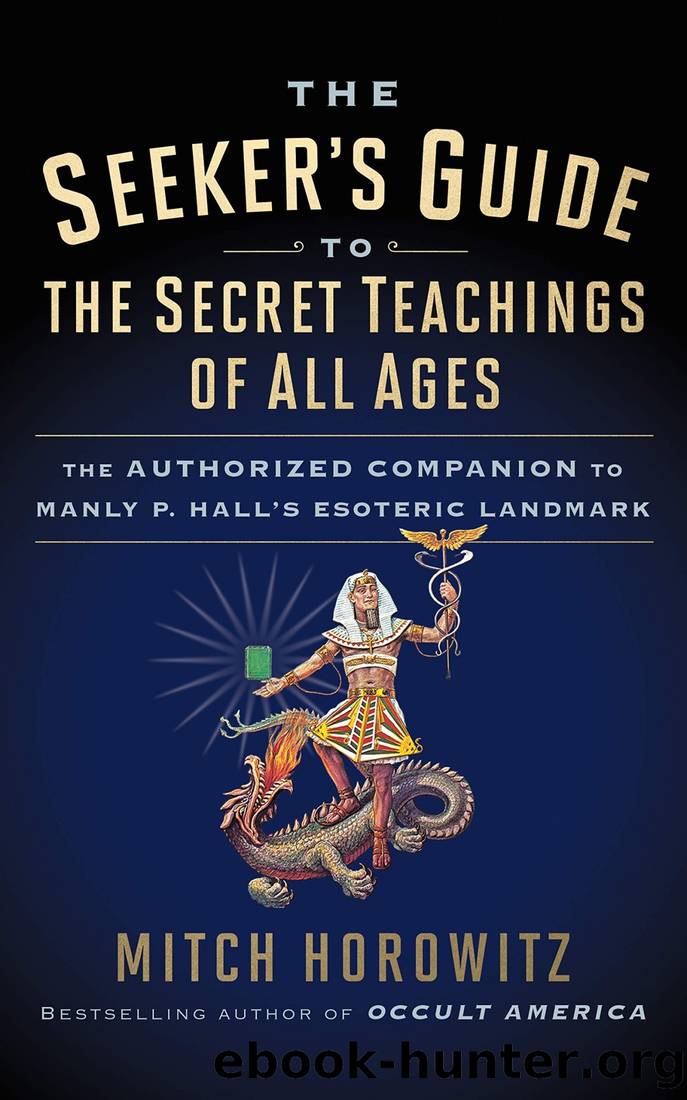
Author:Mitch Horowitz [Horowitz, Mitch]
Language: eng
Format: epub
ISBN: 9781722503185
Google: 5-RKzQEACAAJ
Publisher: G&D Media
Published: 2020-10-13T05:00:00+00:00
* You can learn about this in the 2006 book, The Oracle: The Lost Secrets and Hidden Message of Ancient Delphi by William J. Broad.
LESSON VII
The Role of Secret Societies
The question of âsecret societiesâ is one of the most controversial and dramatic in all of esoteric spirituality. In a sense, it is particularly controversial at this moment in the twenty-first century because we are living through a period in America, and in other parts of the world, where people are suffused with a kind of us-versus-them mentality. A certain degree of conspiracist thought has always been popular within American history, going back to the anti-Masonic scares of the early 19th century, and we seem to be experiencing an upsurge of this kind of conspiracist thinking today, in which a âhidden handâ is thought to be manipulating our destiny.
Itâs worth commenting on that before getting into the question and the history of secret societies. I think that within American culture today, there is a deep and justified hunger for transparency. People feel like there are holes in the straight story, people feel like there are forces at workâfinancial and governmentalâthat do not necessarily have their best interests at heart, and they feel manipulated and locked out of decision-making processes. I think this instinct is correct. But I think this instinct also gets perverted and misdirected into conspiracist thought, in which some sort of perhaps historically real but fictitiously reimagined secret society (the Illuminati, most frequently) is cited as wielding nefarious control over human affairs. People speak in terms of different groups, like the Council on Foreign Relations; Bohemian Grove; the Bilderberg Group; Skull and Bones; the Deep State; Freemasonry, of course; and other organizations, some historically real but reimagined along the lines of being some secret force in human affairs.
The problem I have with this outlook is that it frequently results in this us-versus-them mentality. It is, in certain ways, almost antithetical to the spiritual search, because the conspiracy model locates problems in the world as existing out there, among them; and those of us who are trying to expose the problemâso goes the kind of mood that you find within conspiracist cultureâare somehow always the good guys. Itâs never the mirror that we look in for the problem. Itâs never or rarely our own relationships that we scrutinize. Or our own ethics. But, rather, the notion is that manipulations and mechanizations that oppose the best interests of human flourishment are perpetuated by some other force, thatâs out there somewhere. This, in the ultimate sense, perpetuates an angry, tribal mentality. This way of thought almost never leads to policy ideas or reforms; or to understanding the economic forces that strip the individual of decision-making ability, economic forces that often conceal their profit-making apparatus, so that the individual doesnât realize when he or she is being taken advantage of, such as by health insurers. Rather, the conspiracist model tends to cement a view of life in which the epicenter of good
Download
This site does not store any files on its server. We only index and link to content provided by other sites. Please contact the content providers to delete copyright contents if any and email us, we'll remove relevant links or contents immediately.
Becoming Supernatural by Dr. Joe Dispenza(8225)
Crystal Healing for Women by Mariah K. Lyons(7934)
The Witchcraft of Salem Village by Shirley Jackson(7280)
Inner Engineering: A Yogi's Guide to Joy by Sadhguru(6799)
The Four Agreements by Don Miguel Ruiz(6770)
The Power of Now: A Guide to Spiritual Enlightenment by Eckhart Tolle(5790)
Secrets of Antigravity Propulsion: Tesla, UFOs, and Classified Aerospace Technology by Ph.D. Paul A. Laviolette(5374)
The Wisdom of Sundays by Oprah Winfrey(5166)
Room 212 by Kate Stewart(5130)
Pale Blue Dot by Carl Sagan(5013)
Fear by Osho(4743)
The David Icke Guide to the Global Conspiracy (and how to end it) by David Icke(4723)
Animal Frequency by Melissa Alvarez(4476)
Rising Strong by Brene Brown(4467)
How to Change Your Mind by Michael Pollan(4360)
Sigil Witchery by Laura Tempest Zakroff(4250)
Man and His Symbols by Carl Gustav Jung(4140)
Real Magic by Dean Radin PhD(4134)
The Art of Happiness by The Dalai Lama(4133)
